
I just attended a celebration for TrustDALE Certified Partner Dr. Roof. They occasion? They had gotten their 2,000th Google Review! An impressive accomplishment in a world where reviews are a key tool consumers use in decision-making. As one of my partners, I know Dr. Roof's reviews are real input from actual customers. It's part of my company's seven point review process any company goes through to get the TrustDALE seal and Make It Right Guarantee.
The reality is, so many of the reviews you read on-line are not legit. Many aren't written by customers or even human beings! As a consumer investigator and owner of TrustDALE, I know how to tell the difference between a fake review and a real review from an actual human. Knowing how to spot fake reviews protects household purchasing decisions, including who you hire and where you spend money.
Online reviews influence decisions about contractors, retailers, and local businesses. The Federal Trade Commission now prohibits several deceptive review practices, including fabricated testimonials, paid sentiment, and undisclosed insider endorsements, under its final rule banning deceptive reviews. Fabricated testimonials can distort a company’s brand reputation and hide its true standing. I never treat one clue as proof. Instead, I check the details, the pattern, and the evidence behind the claim.
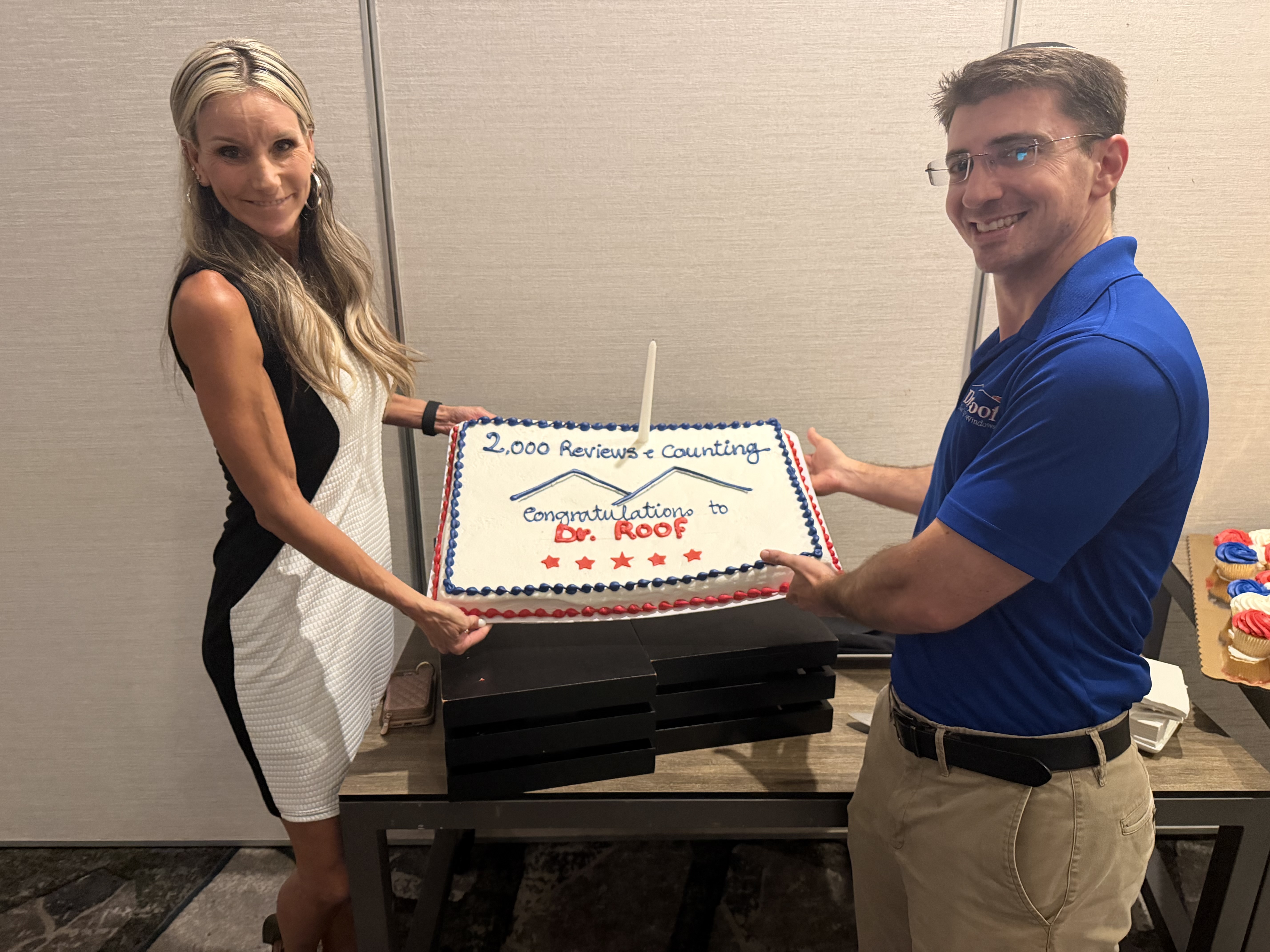
Dr. Roof's VP of Business Development, Karey irwin and General Manager Michael Friedlander celebrate 2,000 reviews
Key Takeaways
- Knowing how to spot fake reviews helps you avoid scams when hiring contractors or buying services.
- Look for details tied to a real project, purchase, problem, or service visit.
- Treat polished language, typos, star ratings, and verified badges as clues, not proof.
- Watch for repeated wording, sudden review bursts, and ratings that don't match the comments.
- Check reviewer history and compare claims with outside records and written documents.
- Get credentials, scope, price, and warranty terms in writing before you commit.
How to Tell the Difference Between a Fake Review and a Real Review From an Actual Human
A trustworthy review usually connects a person to an actual experience. It might name the work completed, explain a delay, mention a technician, or describe whether the price matched the estimate.
When researching local businesses, compare those details across several reviews. In Don't Get Scammed, Get Smart, I advise consumers to slow down and verify before making a decision. Don't hire a company because of one glowing review, and don't reject one because of one angry post.
Look for details only a real customer would know
Read for practical details: the appliance repaired, the room affected, the appointment date, the communication, the quoted price, or the final result. A credible negative review may explain that a crew arrived late but corrected the issue, while a credible positive review may mention a repair that required a return visit for a special-order part.
Authentic reviews contain verifiable operational facts. Generic dramatic scene setting can also appear in fake reviews churned out by offshore content farms, especially when the writing says little about the actual service.
For example, a CalTek Appliance Repair customer described a refrigerator diagnosis, a same-day repair quote, and a later installation after the part arrived. That type of timeline gives you something concrete to weigh.
Spelling errors, imperfect grammar, or emotional wording do not prove a review is fake. Real customers write differently, especially when a leak, broken furnace, or failed appliance has disrupted their day.
Spot repeated language, review bursts, and rating conflicts
Several five-star reviews posted within hours of each other deserve a closer look when they share uncommon phrases or the same sentence structure. A sudden rating jump may also merit questions.
Some shady operators hire black-hat online reputation management agencies to flood listings and artificially boost local search rankings. AI-generated reviews can sound short, uniform, and mechanical.
Another warning sign appears when a five-star rating accompanies criticism, or a one-star rating contains mostly praise. Still, real customers may post around the same promotion, storm event, or company milestone. These are warning signs, not final proof.
Why AI-Generated Reviews and Verified Badges Are Not Enough
Human intuition is a weak detector. A 2025 University of Hawai'i at Manoa study asked 151 consumers to classify six reviews each, producing 906 classifications. They were correct only 53.2% of the time, barely better than chance.

A verified-customer label adds context, but it doesn't prove meaningful service use or personal authorship. On e-commerce product reviews, verified purchases offer similar context, not proof that every claim is accurate. Read the platform's explanation of what it verifies. The FTC also warns that a platform disclosure tool may not always give consumers an adequate disclosure.
Check who wrote the review and what else they have posted
Open the reviewer's profile when the platform allows it. Check for consistency across major review platforms, including a normal mix of businesses, locations, and dates. Accounts that publish nearly identical praise for many companies in a few days deserve extra scrutiny.
Watch for review hijacking on dormant listings, where new praise appears under an old or inactive profile. A new account isn't automatically fake. An older account isn't automatically honest. Reviewer history supports your judgment, but it should never decide the case by itself.
Compare claims with evidence outside the review page
Compare reviews with the business website, license or registration records where applicable, written estimates, warranties, complaint history, and feedback on more than one platform. Inspect review meta, such as posting dates, repeated wording, and unusual timing. A reputable fake review checker can help identify patterns, but it shouldn't replace your own verification. Project photos and references can help, but ask when they were taken and what work they show.
Before relying on any review total, confirm it on the company's current google business profile or a verified TrustDALE business page for local businesses. A high rating can include honest complaints, and a large review count doesn't authenticate every post.
A Safer Way to Use Online Reviews Before Hiring or Buying
Use online reviews as a starting point when evaluating contractors and other local businesses. They should help you form questions, not replace due diligence.
Before you hire, confirm insurance and local licensing requirements, request a written scope, compare itemized estimates, check references, and read warranty terms.
Ask questions that expose vague or manipulated claims
Ask whether reviewers were actual customers and whether the company uses transparent review management or aggressive online reputation management. Ask whether it offers incentives for reviews, including incentivized reviews.
Request written answers about how it handles complaints, sudden review surges, and the work included in the quoted price.
Be cautious when a company pressures you to ignore negative feedback, pay before receiving details, or post a review with required positive wording. Reputable businesses can explain their process without demanding blind trust.
Know when to report a suspicious review
Flag a review when it appears to come from a nonexistent customer, describes work the person could not have received, copies another post, or hides paid or insider involvement. Cross-reference the business's contact details on its google business profile, then save screenshots, dates, receipts, and messages before reporting it.
The Federal Trade Commission's Consumer Reviews and Testimonials Rule took effect October 21, 2024. Its consumer review rule guidance prohibits creating, buying, selling, or spreading fake reviews, as well as reviews conditioned on required positive or negative sentiment. The rule targets deceptive business conduct, not consumers sharing honest experiences.
Frequently Asked Questions
Can a business remove a real negative review?
A business can ask a platform to review content that violates its rules, such as harassment or impersonation. It may also report content through its Google Business Profile. However, it shouldn't suppress honest negative reviews simply because they're unfavorable.
Are all five-star reviews suspicious?
No. A five-star review can be genuine, especially when it includes project details and matches a broader pattern of customer feedback. Read the content rather than judging the stars alone.
Should I trust photos attached to a review?
Photos can help when they show a recognizable project stage or repair result. However, reverse-image searches and questions about timing can reveal stock images or photos used in unrelated posts.
What if the company has no reviews?
A newer company may have few or no reviews. In that case, put more weight on licensing, insurance, references, written estimates, and the owner's willingness to document promises.
Can a business ask customers for reviews?
Yes, if it asks honestly and doesn't require a positive rating or hide incentives. Reputable businesses invite authentic customer feedback from everyone, including customers with complaints.
Put Evidence Ahead of Appearances
No detector, star rating, or verified badge can replace careful judgment. Read online reviews for specific experiences, compare patterns across sources, verify the provider, and get important promises in writing.
My rule from my book Don't Get Scammed, Get Smart!: Seven Steps to Outsmart Today's Most Dangerous Post-COVID Scams remains simple: trust needs evidence and accountability. Real consumer trust is earned through documented evidence and verified performance, not polished reviews. A review should start your investigation, not end it.